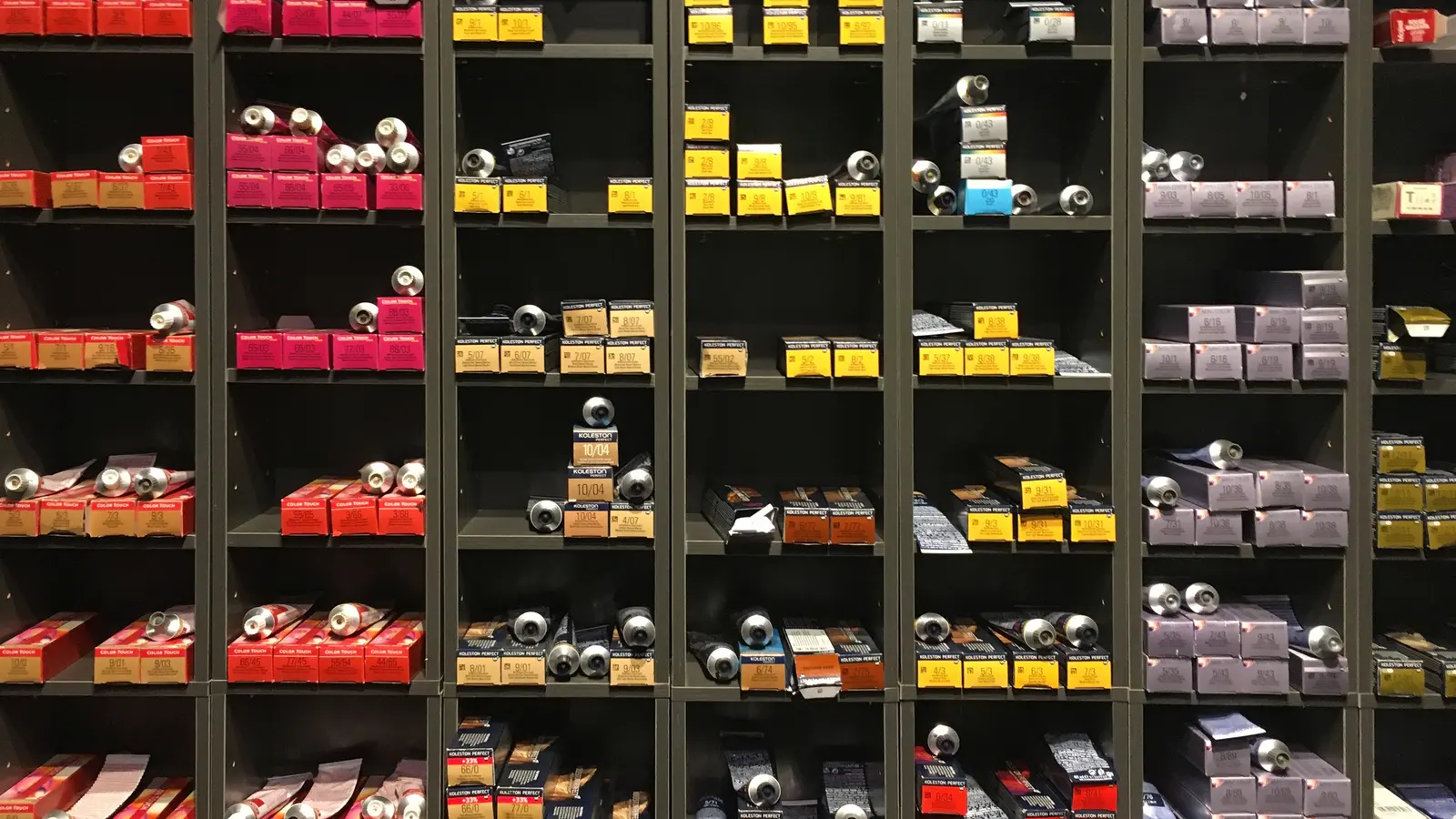
In a beauty-supply store, the hair care wall earns more per foot than anything else on the floor — and it's usually the part nobody actually planned. A brand's set here, a closeout there, a bottom shelf that hasn't moved since the lease was signed. Below is the wall worked through foot by foot for a store of about 900 square feet, with every number shown so you can rerun it on your own sales.
How much wall hair care should get
A 900-square-foot store — call it 30 by 30 feet — has about 120 feet of perimeter. Take out the entrance, the register counter and the backroom door, and 90 to 100 feet of usable wall is left. Hair care realistically gets 16 to 24 feet of it: four to six 4-foot sections, each with 5 or 6 shelves.
That's 80 to 144 feet of shelf edge. Below 16 feet you can't give each need its own section, and the wall turns into a brand jumble. Above 24, something else — skin care, lashes, tools — gets pushed onto a center gondola where it's harder to shop.
Sort by need first, brand second
Shoppers walk in with a problem, not a brand name: dry ends, edges that won't lie flat, a kid's wash day. Block the wall by need. A typical set, left to right:
- Moisture & leave-ins — leave-in creams, butters, moisturizing milks. Usually the biggest block.
- Edge & hold — edge control, gels, styling foams.
- Oils & scalp — scalp and growth oils, hot-oil treatments.
- Curl definition — custards, curl creams, puddings.
- Relaxers & color — kits and boxed color, kept together. Fewest units, highest ticket.
- Kids — its own section and its own sign. Parents shop it as a set.
Size each block from your own numbers, not from habit: its share of hair care units over the last 90 days, rounded to whole shelves. A block that sells 30% of your hair units gets about 30% of the shelves — on a 24-foot, 6-shelf wall, 11 of 36.
Inside each block, run brands vertically. Each brand owns a column from the top shelf to the bottom instead of a whole shelf, so a shopper looking for a leave-in finds every brand's leave-in at the same height.
Price tiers by shelf height
Height decides what gets picked up. On a 6-shelf section:
- Shelf 1, top — premium and new items. Seen from the aisle, reached for on purpose.
- Shelves 2–3, eye level — fast movers and your best-margin mid-price SKUs.
- Shelf 4, waist — second-tier SKUs and the sizes shoppers compare.
- Shelves 5–6, bottom — value sizes, big tubs and the tail. Someone who wants a 32 oz tub will bend for it.
On a 5-shelf section, fold the waist shelf into the bottom tier and leave eye level alone.
Facings math
A facing is one unit across the front of the shelf. The rule: 2 to 3 facings for fast movers, 1 for the tail. A fast mover sells at least one inner pack every two weeks; the tail sells less than one inner pack in 8 weeks.
Facings times depth is what the shelf holds, and it should take a full inner pack before it runs dry. A 12 oz jar sits 3 deep on a 12-inch shelf, so 3 facings hold 9 jars. When the shelf is down to 3, a pack of 6 goes straight up — no half-pack left in the backroom. Two facings hold 6: fine for a pack a month, tight for a pack a week.
The tail gets one facing. A single facing of a slow SKU is a test; three facings of it is a bet you're already losing.
A worked example: one 4-foot section
One moisture section — 4 feet wide, 6 shelves, four vertical brand blocks of about 12 inches each: Cantu, Mielle, SheaMoisture and ORS Olive Oil. Facings per SKU run from 1 on the tail shelf to 3 at eye level.
| Shelf | What goes there | SKUs | Facings |
|---|---|---|---|
| 1 · top | Premium and new items | 8 | 8 |
| 2 · eye | Fast leave-ins, one per brand | 4 | 12 |
| 3 · eye | Milks and creams, mid-price | 6 | 12 |
| 4 · waist | Second tier, compare sizes | 8 | 12 |
| 5 · low | Tail and trial sizes | 12 | 12 |
| 6 · bottom | Value sizes, big tubs | 4 | 8 |
| Total | One 4-foot section | 42 | 64 |
Shelf 2 carries the section: four SKUs, three facings each. If a brand's leave-in doesn't sell a pack every two weeks, it doesn't get shelf 2. Five sections at this density come to roughly 200 hair care SKUs.
Inner packs, master cases and the backroom
Backroom space in a store this size is a few shelving units, not a warehouse aisle. That's where inner packs earn their place: most of our SKUs sell in packs of 6 or 12, a pack fits the facing plan above, and a handful of packs clears the $140 reorder minimum without buying depth you'll trip over.
Full master cases take an extra 4% off, and the trade-off is plain arithmetic. A 48-count case of a SKU that sells 4 units a month is 12 months of backroom shelf, paid up front, to save 4%. The same case of a leave-in that sells 12 a week is gone in four weeks — that 4% is worth having. Buy the master case only when it sells through in six weeks or less. For the reorder point itself, see the two-week rule.
Peg hooks by the register, signs by need
Edge brushes, satin bonnets, wig caps and combs don't belong on a shelf. Hang them on peg hooks within reach of the register, where they catch a shopper who is already paying. The Annie satin sleep bonnet ships in inner packs of 12 — code UB-T604 on our staples list — and Denman and Ebin New York brushes share the panel.
Sign the wall by need, not by brand. Every package is already a brand sign; what a shopper can't see from the aisle is where "edges" stops and "curl definition" starts. Use the same words as your need blocks, on a header at the top of each section, where they don't compete with price tags.
Review the wall every 8 weeks
Every 8 weeks, pull hair care unit sales by SKU, sort low to high and take the bottom 10% off the wall. On a 200-SKU wall, that's 20 SKUs out and 20 slots open: about half go to fast movers that sold out during the period, half to new items tested at one facing. Clear the cuts from a basket at the register — stock sent to the backroom to wait for a better week usually waits for good.
This is where our line codes earn their keep. Every hair care SKU on the Urbanbuy pricelist carries the H line letter in its code — UB-H101, UB-H114 and so on — and the same code prints on the pick ticket and the carton label. Filter the pricelist CSV to line H, add a column for your need block, and you have the source list for your planogram. At each review, add your 8-week units and sort: the bottom 10% are the last rows on the sheet. When the reorder lands, cartons marked H go straight to the wall, after the checks in receiving a wholesale delivery.
Key takeaways
- Give hair care 16–24 feet of wall: four to six 4-foot sections, 5 or 6 shelves each.
- Block by need, then vertical brand columns, then price tier by shelf height.
- 2–3 facings for fast movers, 1 for the tail — sized so an inner pack of 6 or 12 fits when the shelf runs low.
- Take a master case, an extra 4% off, only when it sells through in six weeks or less.
- Bonnets and brushes on peg hooks at the register; signs name the need, not the brand.
- Every 8 weeks, cut the bottom 10% of SKUs by units.